SkifEmergency
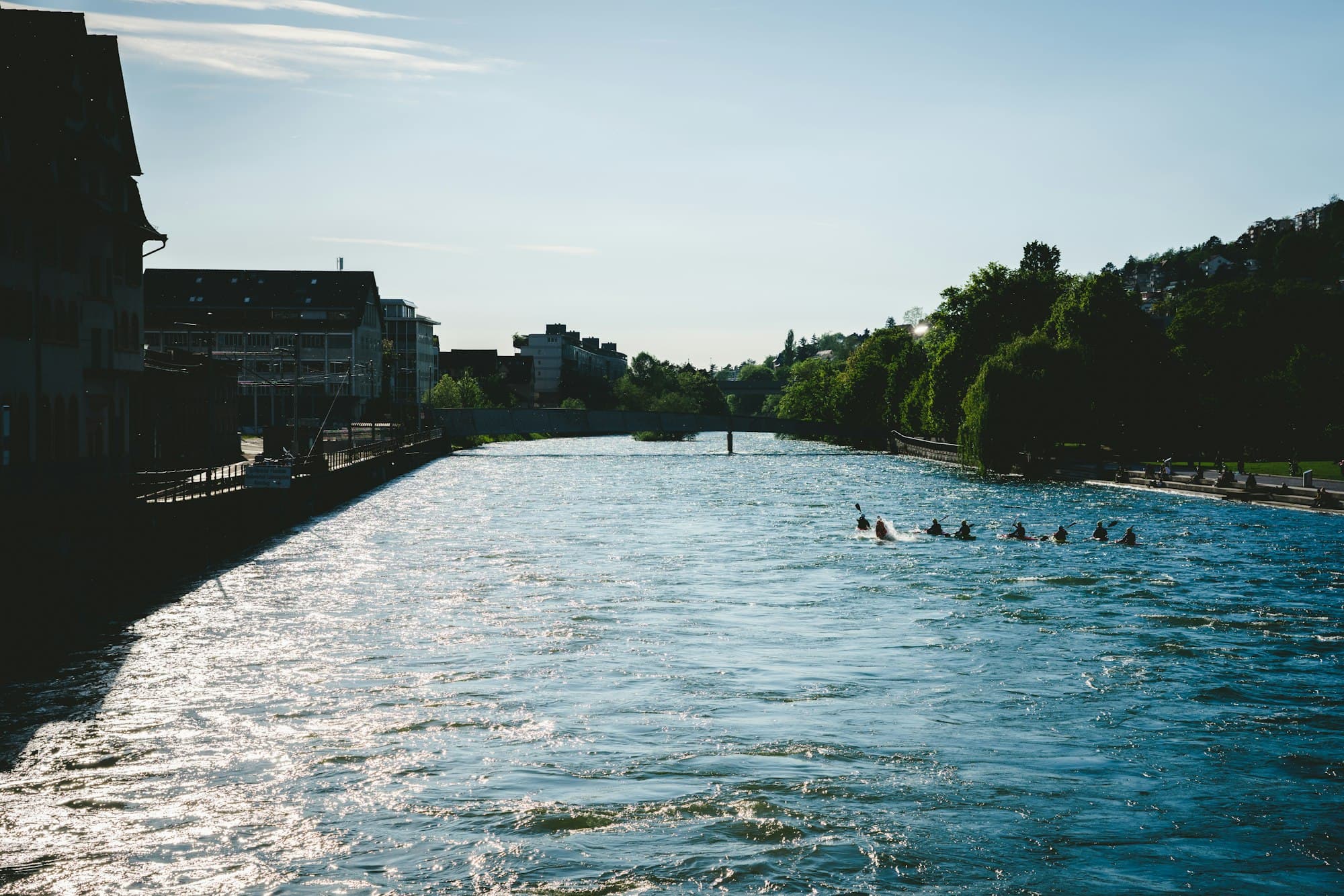
A line of kayaks on a wide, sunlit city river, with people sitting along the bank under the trees.

Guide · Places and surroundings · Health and emergencies · 3 sources

The water is free. Respect it.

Swiss lakes and rivers are one of the best things about living here, and Skif wants you in them. They are also where people die every summer: 43 drowned in Switzerland in 2025, against a long-term average of about 50 a year [1].

The Swiss Lifesaving Society (SLRG) reduces what it knows to two sets of six rules, one for bathing and one for rivers [2] [3]. They are short because they are the ones that matter.

In this guide

The six bathing rules

SLRG's Baderegeln, in English [2].

Children only with an adult
Small children within arm's reach. Drowning is quick and quiet; it does not look like the films.
Never drunk or high
And never on a full or completely empty stomach.
Never jump in overheated
The body needs time to adjust. Wet your skin and go in slowly after hours in the sun.
Don't jump into murky or unknown water
What you cannot see can hurt you: rocks, branches, shallow ground.
Air mattresses and swim aids are not for deep water
They give no safety there. They drift, deflate and tip.
Never swim long distances alone
Even the fittest body can have a weak moment.

The six river rules

SLRG's Flussregeln, in English [3]. They matter on the Aare, the Rhine, the Reuss and the Limmat.

Life jacket in a dinghy
Everyone in an inflatable boat wears one.
Respect the stated load
Never put more on a boat than its label allows.
Never tie boats together
Tied boats can no longer be steered.
Scout unknown stretches first
Weirs, bridge piers and fallen trees are where people get pinned. Know where they are and where you will get out before you get in.
Open water is for strong swimmers
Rivers, ponds and lakes: only good, practised swimmers.
The colder the water, the shorter the swim
Cold leads to cramp. Early-summer river water is far colder than the air above it.

Before you get in

Know your exit

On a river, pick the steps or ladder where you will get out before you get in, and the one after it in case you miss it.
Go with someone

Somebody on the bank who knows where you went in and when you should be back.

Dry bag, bright float

A swim buoy makes you visible to boats and gives you something to hold. It is not a life jacket.

If someone is in trouble

Call 144 straight away, or have someone else call while you act. Reach or throw before you go: a branch, a rope, a ring buoy, anything that floats. Untrained rescuers drown alongside the person they swim out to.

SLRG runs swimming and lifesaving courses across Switzerland, and the Academy's first-aid courses cover resuscitation. Both are a few hours, and both are the kind of thing you hope never to need and are glad to have.

Sources

Read and checked on 21 October 2026. Quotes are from the sources as published.

  1. [1]43 Menschen sind im Jahr 2025 in der Schweiz ertrunken — blue News / Keystone-SDA, reporting the SLRG, 2026
  2. [2]Baderegeln — Schweizerische Lebensrettungs-Gesellschaft SLRG, 2026
  3. [3]Flussregeln — Schweizerische Lebensrettungs-Gesellschaft SLRG, 2026